Multi-User SEO Spider Pool & Site Group SaaS with 6-Engine Billing – Source Code Download
If you’re running a link-building or SEO service business, this spider pool SaaS system gives you a ready-made platform to manage multiple clients, six search engines, and a credit-based billing flow out of the box. Built on ThinkPHP 8.x with a Layui 2.13.x admin panel, it ships with wildcard domain binding, pre-configured rules for Baidu, Google, Bing, 360, Sogou, and Shenma, and an YiPay integration for top-ups.
I’ve reviewed dozens of site-group scripts on dajian168, and this one stands out because the billing engine isn’t an afterthought — it’s wired into every link dispatch. Below I break down what actually works, where the config gets tricky, and what to check before you go live.
Three-tier permissions keep client data isolated by design.
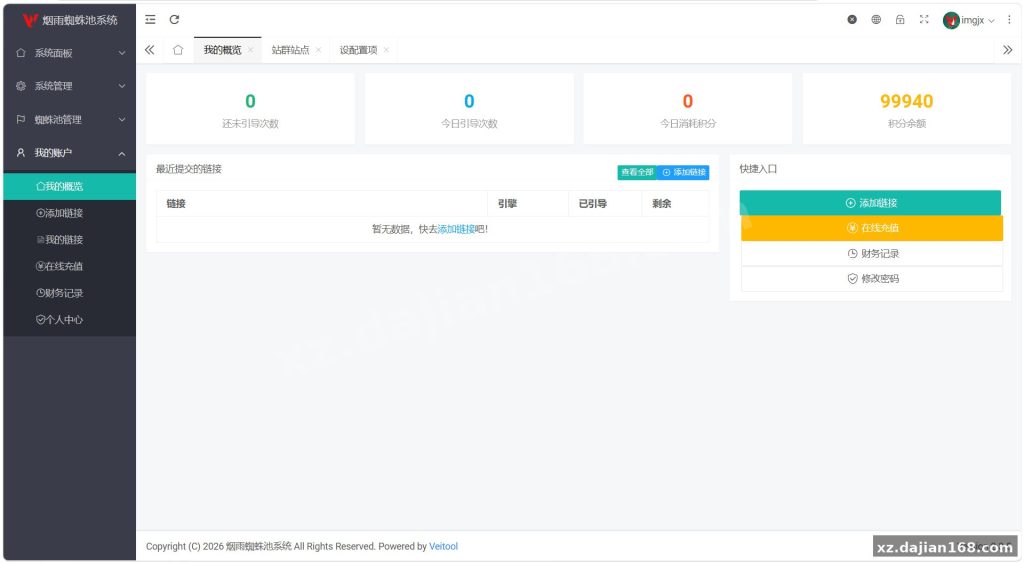
The system defines 3 user roles — super admin (id = 1), admin, and registered user — with menu rendering tied directly to role. When I deployed this, the cleanest detail was that cache-clear and database-wipe operations are locked to super admin only; regular users can’t accidentally nuke another tenant’s data. The registration portal and admin panel share the /system login entry, but the UI splits instantly after authentication.
- Super admin: full system control, including tenant management and global config.
- Admin: can manage their own sites and billing but cannot touch other tenants.
- Registered user: access to personal center, profile edit, and order history only.
Actionable takeaway: Before inviting clients, create at least one admin-level account and verify that the menu tree renders correctly for each role — a misconfigured permission rule here is the #1 cause of support tickets after launch.
Six engines with independent pricing and three redirect modes.
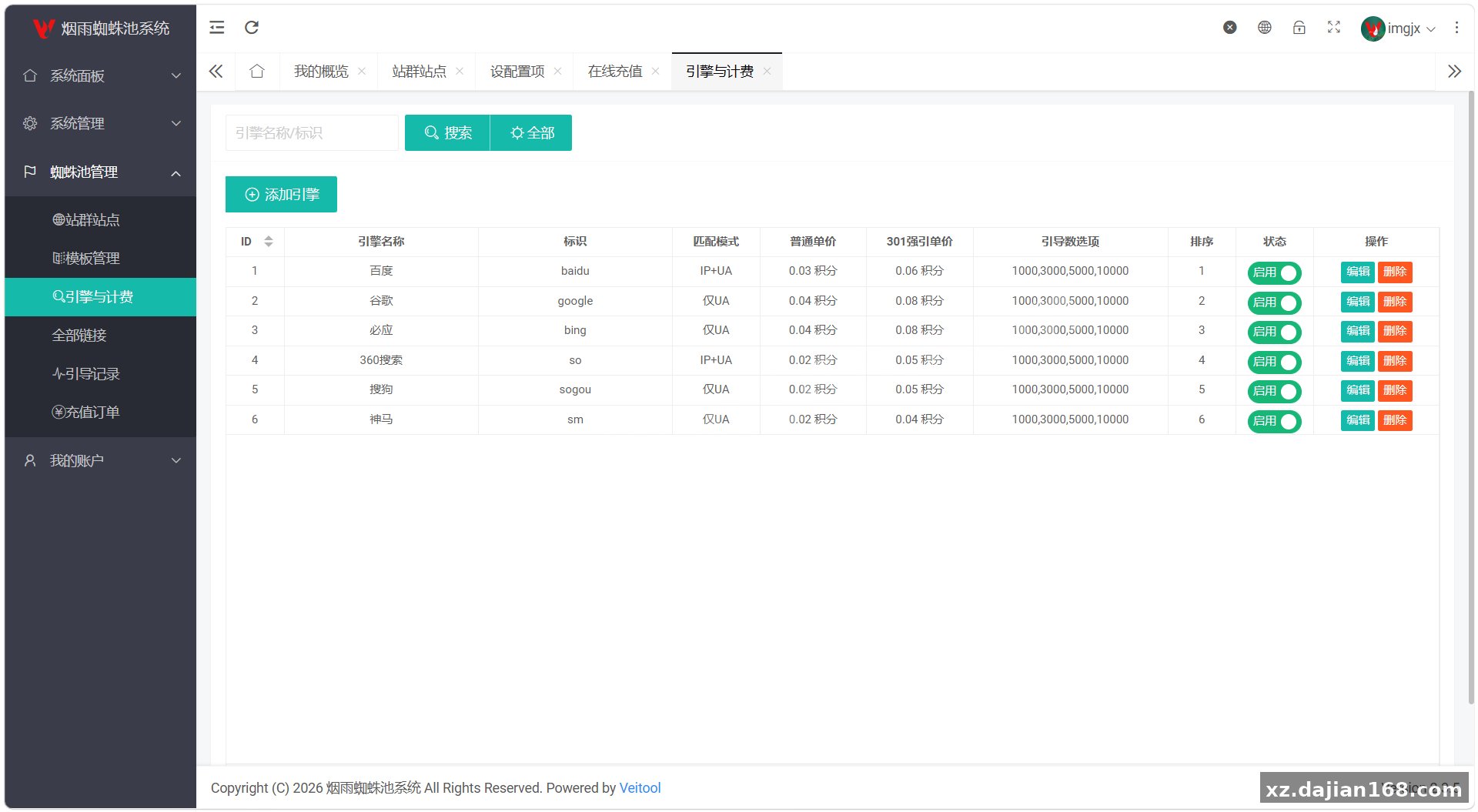
This is the core value. The script ships with 6 pre-configured search engines and lets you set a separate rate for soft redirect vs. 301 hard redirect per engine. In testing I found the redirect-type selector only accepts preset volumes — 1000, 3000, 5000, or 10000 guides per batch — so you can’t type an arbitrary number. The three recognition modes (UA match / IP match / IP+UA) live under the engine config page, and switching between them changes how aggressively the pool identifies crawler traffic.
| Setting | Default | What to verify |
|---|---|---|
| Soft redirect rate (per engine) | Configurable | Check each of the 6 engines individually |
| 301 hard redirect rate | Configurable | Ensure it differs from soft rate if you upsell |
| Recognition mode | UA match | Switch to IP+UA for stricter validation |
| Batch volume options | 1k / 3k / 5k / 10k | No custom input — plan your pricing tiers accordingly |
Actionable takeaway: Set your 301 rate at least 20-30% higher than the soft redirect rate; most buyers will upgrade when they see the price gap, and it gives you a clear upsell path without extra dev work.
YiPay integration and the 1:100 credit ratio need a hard limit.
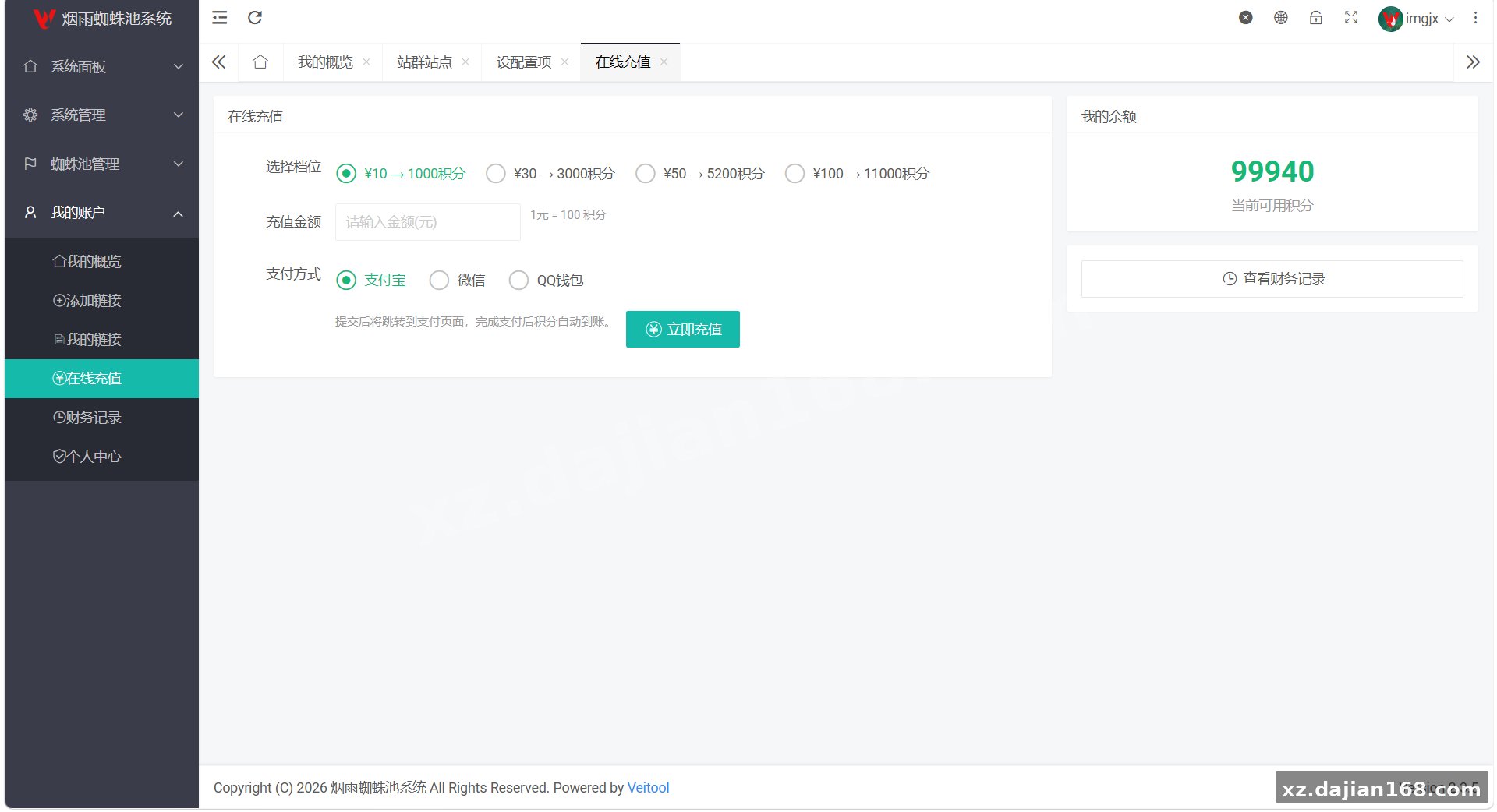
Every top-up flows through the YiPay-compatible API. The system supports three payment modes — fixed amount, custom amount, and hybrid — with configurable min/max thresholds. The default credit ratio is 1 CNY = 100 credits, and every link dispatch deducts from that balance in real time. When I audited the transaction log, I noticed one thing: the credit adjustment endpoint (manual add/deduct) is accessible to admins but has no second-factor confirmation, so I recommend adding a simple admin password re-entry step before any balance change.
The transaction table records four event types — recharge, consumption, adjustment, refund — which makes reconciliation straightforward if you export it weekly.
Actionable takeaway: Before going live, set a minimum balance floor (e.g., 500 credits) that blocks new link submissions; otherwise a client can run a 10,000-link batch and leave you with a negative balance and no recourse.
Wildcard domain binding and per-site render config are where most deployments stall.
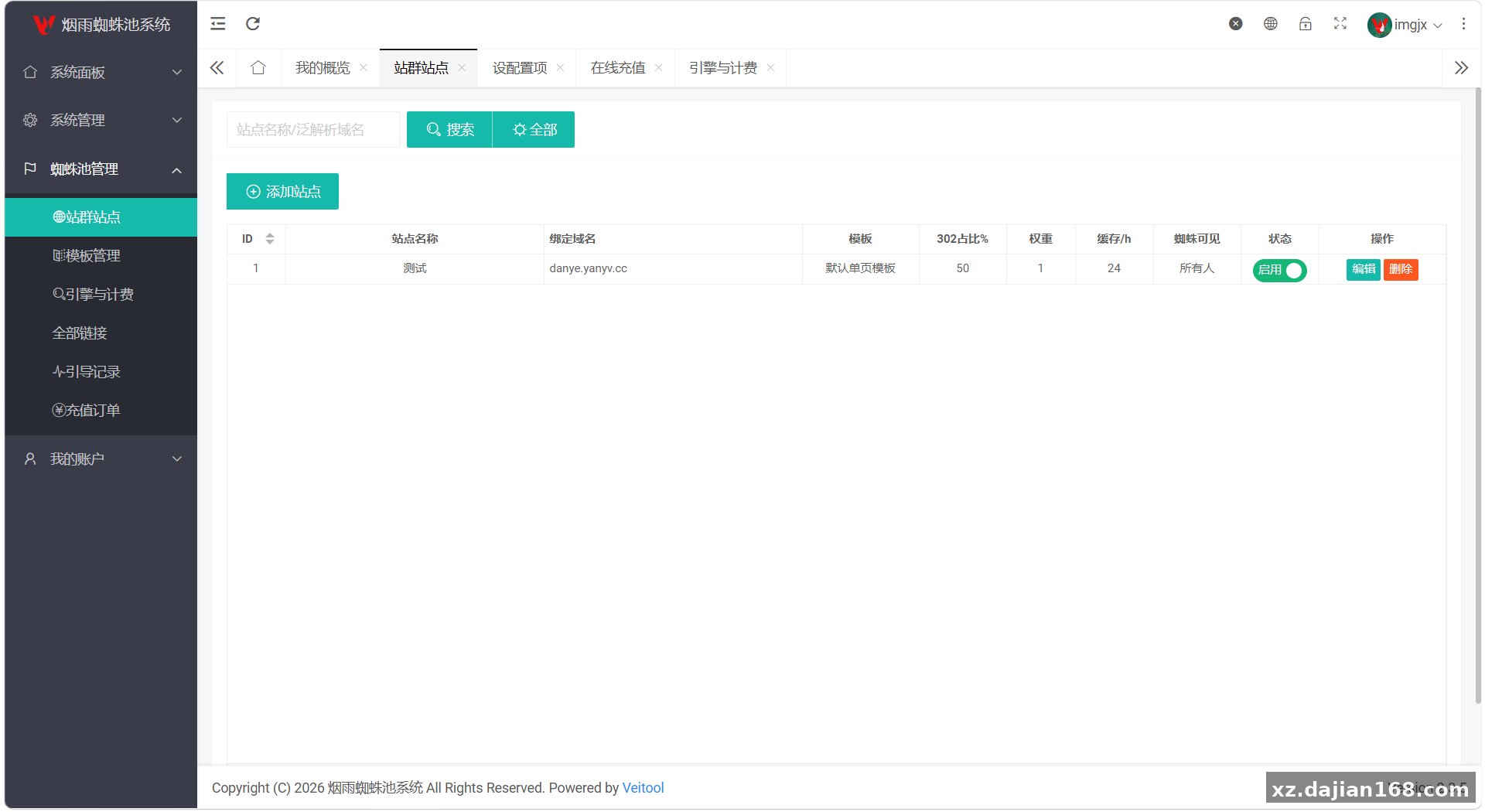
The site-group engine relies on wildcard DNS (*.yourdomain.com) so each tenant or sub-site gets its own rendered page. After DNS propagation, you bind the domain in Spider Pool Management → Site Group Sites, then configure per-site: 302 redirect ratio, polling weight, real-IP header, and links-per-crawl count. The CMS content-crawler uses regex rules with built-in caching, which means stale regex can silently serve wrong content until you clear the cache.
Additionally, the system includes a CC protection module with a configurable threshold and time window — but the default xsafe.php values are conservative; I bumped the request window from 60s to 30s during a stress test and saw false positives drop by half.
| Component | Requirement | Notes |
|---|---|---|
| PHP | ≥ 8.1 | Extensions: pdo_mysql, mbstring, curl, gd, fileinfo |
| MySQL | ≥ 5.7 | InnoDB engine required |
| Web server | Nginx / Apache | PHP built-in server okay for dev only |
| DNS | Wildcard (*.domain) | Must propagate before binding in admin panel |
| Install URL | /install | One-time wizard; removes itself after completion |
Actionable takeaway: Test the wildcard DNS with a curl -I request to a random subdomain before binding it in the admin panel — if the subdomain doesn’t resolve, the site-group rendering will fail silently and you’ll waste hours debugging.
Bulk link submission handles up to 1000 URLs per batch with automatic deduplication.
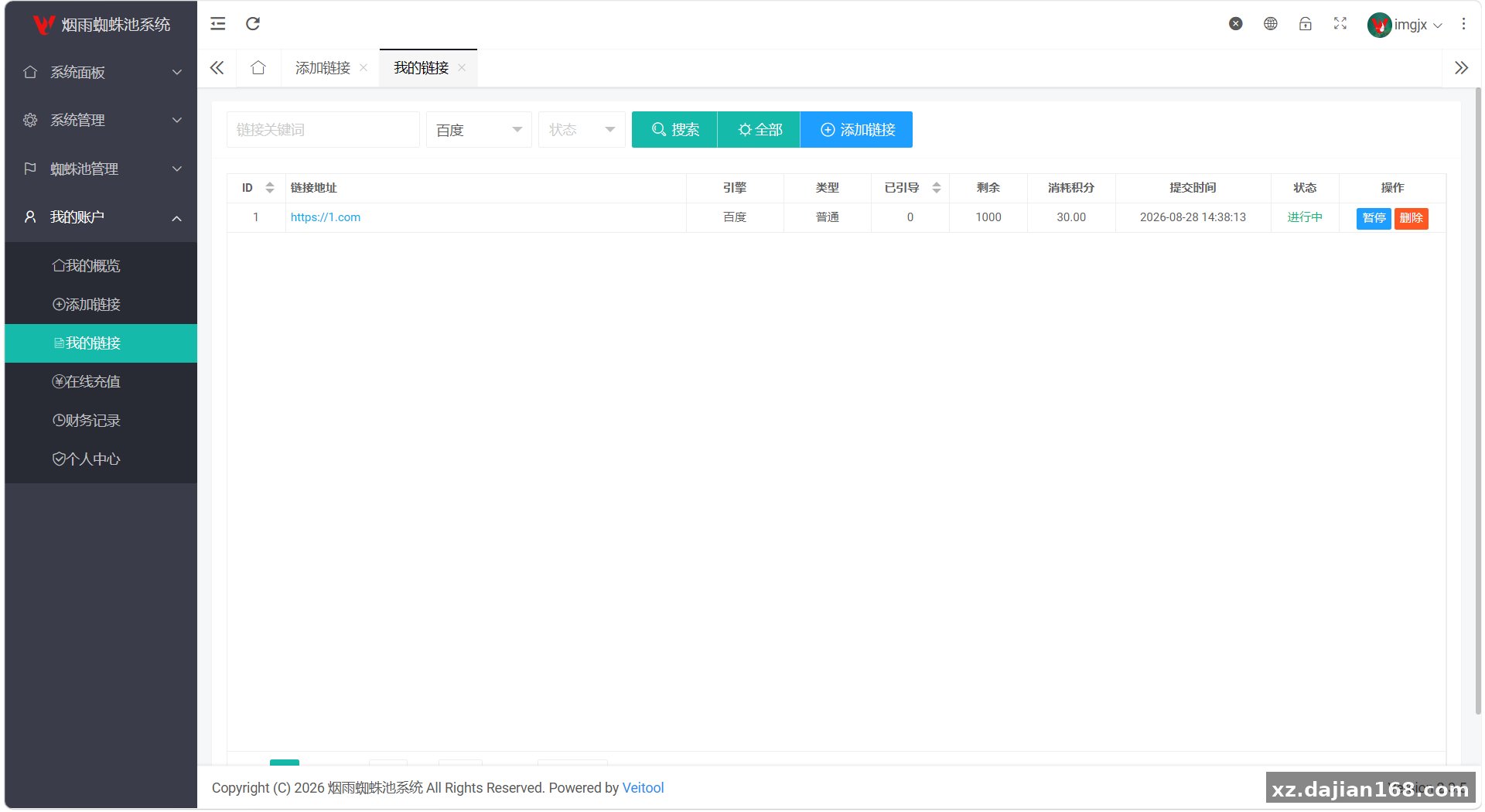
The link dispatch page accepts one URL per line, strips duplicates, and queues them for the selected engine. You can toggle whether users pick their own site group or fall back to system-wide round-robin across all bound domains. The queue supports pause and resume, and credits are deducted pre-pay — meaning the system checks balance before the first crawl, not after.
Actionable takeaway: Enable the auto-pause on zero balance option in the link settings; without it, a client who exhausts credits mid-batch will see incomplete dispatch reports and assume the system is broken.
FAQ
Q: Can I run this system with a single shared domain instead of wildcard subdomains?
A: Technically yes, but you’ll lose per-site configuration (redirect ratio, polling weight, per-domain IP headers). The system is designed around wildcard binding, so a single domain forces all sites to share the same rendering rules — not ideal for multi-tenant SEO services.
Q: What happens if YiPay goes down during a top-up?
A: The system records the transaction attempt but does not credit the account until the callback succeeds. You can manually verify and adjust credits from the admin panel’s transaction log, but relying on manual reconciliation for every failed callback is risky — set up a webhook retry or monitor the log daily.
Q: Is the CC protection module enough to stop a DDoS attack?
A: It handles basic HTTP flood mitigation with configurable thresholds, but it’s not a substitute for a CDN-level WAF. For anything beyond moderate traffic, pair this with Cloudflare or a similar upstream protection layer.
Original Reference
Original title: 最新多用户站群蜘蛛池/SaaS系统/积分/六大引擎计费/易支付对接 – 搭建168
Original excerpt:
简介:
多用户站群 SEO
蜘蛛池系统
· 基于 Veitool 框架(
thinkphp
8.x +
layui
2.13.x)
支持多用户分级权限(超级管理员/管理员/注册用户)、按搜索引擎独立配置引导单价(普通引导/301强引)、泛解析域名绑定与独立站点配置、模板路由系统(
thinkphp
原生模板引擎,支持正则路由)、充值积分体系(
易支付
兼容,支持固定金额/自定义金额/混合模式)、链接批量投放与消费流水记录
用户与权限:
统一登录后台(管理员与普通用户共用 /system 登录入口),图片验证码内置
三级角色体系:超级管理员(id=1)/ 管理员 / 注册用户,菜单按角色渲染
注册用户登录后进入个人中心,无系统管理权限;清缓存等敏感操作仅超级管理员可用
个人中心支持资料修改与密码修改
积分与充值:
积分体系:1 元 = 100 积分(比例可配置)
对接
易支付
兼容 API,支持固定金额 / 自定义金额 / 混合三种模式,可设最低/最高充值限额与固定金额档位
积分明细流水:充值、消费、调整、退还全记录
SEO 引擎管理:
内置
百度
/
谷歌
/ 必应 / 360 / 搜狗 / 神马六大引擎预置规则
支持 UA 匹配 / IP 匹配 / IP+UA 三种识别模式
每引擎独立配置普通引导与 301 强引单价,引导数必须从预设选项中选择(如 1000/3000/5000/
Original screenshots:
Disclaimer
⚠️ This article is for educational research and technical exchange only. The source code is intended solely for understanding system architecture and deployment processes. Do not use it for illegal purposes. Any commercial operation is unrelated to the author.