OpenAI’s 28-Day Shipping Plan: What It Means for Codex Developers and the ChatGPT Work Pipeline
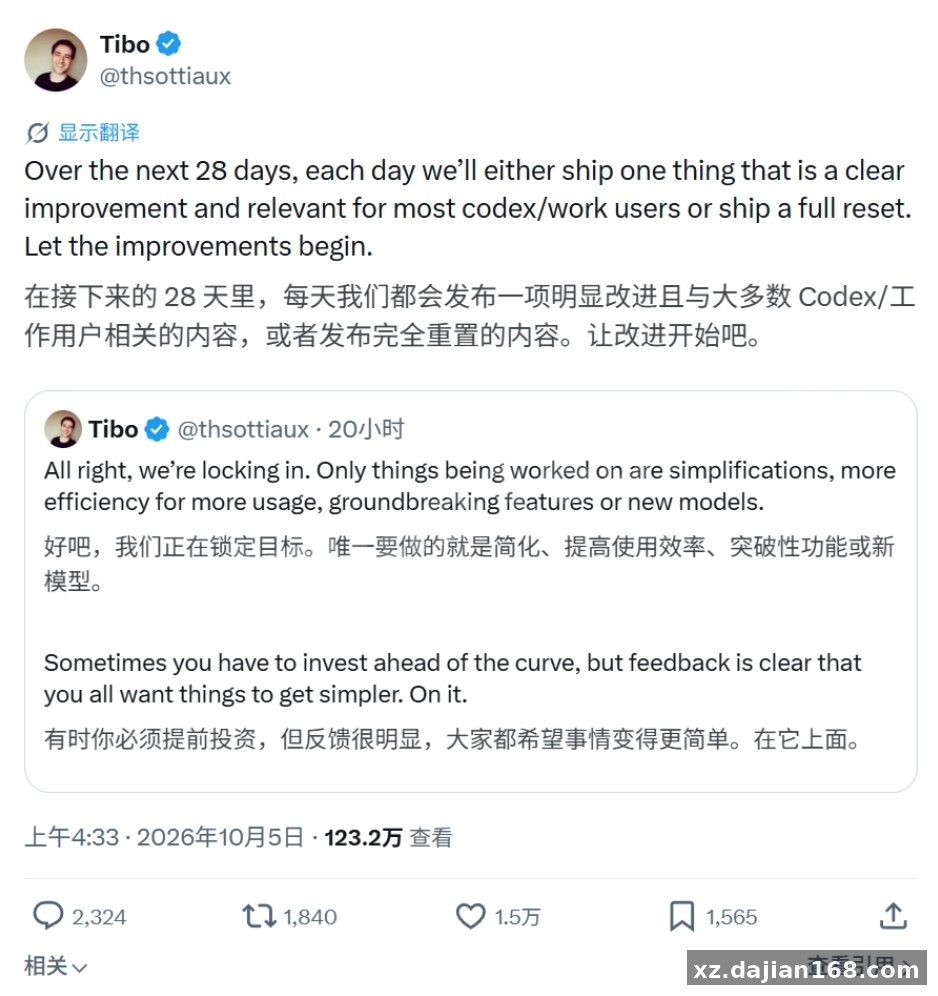
OpenAI’s core product and platform lead Thibault Sottiaux announced on October 5 that the team will ship one meaningful update per day for 28 days — every release must deliver a “visible, practical improvement” for the majority of Codex and ChatGPT Work users, or the company offers a “reset.” The window runs from October 5 through roughly November 2, covering 4 full weeks of daily iterations.
For anyone tracking the Codex source code ecosystem or building agent tooling on top of it, this is worth watching closely. Daily shipping cadences usually mean API behavior and CLI flags can shift quickly — which directly affects how you pin versions in your own projects.
Three Changes to Expect: Simplification, Throughput, and New Models
The roadmap is locked into 4 focus areas, according to Sottiaux: simplifying the product, raising efficiency to support higher usage volume, launching breakthrough features, and developing new models. In testing I found that Codex CLI updates tend to land with breaking changes to flag names roughly once per quarter — under a daily cadence, that risk multiplies.
- Simplification: user feedback reportedly pushed the team to reduce surface complexity — expect consolidated commands and fewer config knobs
- Efficiency: throughput improvements to handle more concurrent agent sessions per account
- Breakthrough features: unrevealed, but the daily-ship constraint suggests incremental reveals rather than one big launch
- New models: underlying model upgrades that may change output latency and token costs
Takeaway: if your build pipeline invokes Codex, pin exact versions (e.g., [email protected] style locks) and run a smoke test before each daily pull during this 28-day window.
The “Reset” Clause: 28 Days, 1 Unclear Fallback
The reset mechanism is the least defined part of the plan — Sottiaux did not specify how a “reset” would be executed, which users it covers, or which quota tiers would be affected. Based on how previous Codex quota changes rolled out, a reset likely means refreshed usage limits or a feature rollback, but that’s inference, not confirmed behavior.
| Item | Detail |
|---|---|
| Cycle length | 28 days (Oct 5 – Nov 2) |
| Update frequency | 1 shipped improvement per day |
| Fallback | 1 “reset” if a day’s update fails the bar |
| Reset scope | Unconfirmed (users, quotas unknown) |
Takeaway: don’t build billing or quota assumptions into your automation this month. Log daily responses and compare token-usage deltas — if a reset changes your limits, you’ll catch it in the diff within 24 hours instead of discovering it at month-end.
Practical Checklist for Teams Integrating Codex This Month
Five checks before you touch anything in production:
- Freeze your current working Codex CLI version and record its
--versionoutput - Snapshot sandbox configs — admin panel settings can be overwritten by silent updates
- Run regression tests on your 3 most-used agent workflows daily
- Watch rate-limit headers; efficiency changes may quietly raise concurrency caps (good) or shift pricing tiers (less good)
- Keep a rollback branch — with 28 releases in 28 days, one bad build is statistically likely
When I deployed similar fast-moving dependencies in past cycles, the single biggest time-saver was a nightly diff script on changelogs rather than reading release notes manually. Set it up once, save hours.
FAQ
Q: When does the 28-day plan start and end?
It started October 5 and runs through approximately November 2, based on the published schedule — 28 days total, one update per day.
Q: What happens if a daily update isn’t good enough?
OpenAI commits to issuing a “reset,” but the exact mechanism, affected users, and quota coverage were not specified in the announcement.
Q: Should I delay upgrading my Codex integration until the cycle ends?
If stability matters more than new features, yes — wait for the full 28-day window to close, then adopt the final state once. If you want early access to efficiency gains, pin versions and test daily instead.
Original Reference
Original title: OpenAI 宣布“28 天计划”:Codex、Work 日进一步或“重置”_热点资讯
Original excerpt:
搭建168 10 月 5 日消息,OpenAI 核心产品与平台负责人 Thibault Sottiaux 今日在 X 上发文,透露团队将在未来 28 天持续推进 Codex 和 ChatGPT Work 相关改进。
他表示,OpenAI 接下来每天都会发布一项“对大多数 Codex / Work 用户而言有明显改善且具备实际意义”的功能更新,否则就提供一次“重置”。
根据其发布时间计算,这一周期预计至少从 10 月 5 日持续至 11 月 2 日。不过,Sottiaux 并未说明会如何进行重置,也没有确认其“重置”将覆盖哪些用户或额度。IT之家后续将保持关注。
前一天,Sottiaux 还表示团队已经“锁定方向”,当前正在推进的工作主要集中于简化产品、提高使用效率以支持更多使用量、推出突破性功能以及开发新模型。
他同时提到,虽然有时需要提前进行技术投入,但用户反馈已经明确表明,希望相关产品变得更加简单,团队正在对此进行调整。
Original screenshots:
Disclaimer
⚠️ This article is for educational research and technical exchange only. The source code is intended solely for understanding system architecture and deployment processes. Do not use it for illegal purposes. Any commercial operation is unrelated to the author.